ALL SAINTS' CHURCH
and Heritage Centre
ASTON ON TRENT
Tickhill Tomb Restoration Phase Two Update
Restoring, Protecting & Celebrating our Heritage
All Saints’ Church: The Tickhill Tomb
Project Update: … Date: 5/11/26
A recent visit to Skillingtons to view the restoration of the tomb proved to be a fascinating insight into the careful process of detailed examination and cleaning.
The tomb is now in separate sections, side and end panels and the separated effigies so they can be worked on independently.
Of some surprise was the discovery of miniscule fragments of coloured paints, green on the pillows, red on Tickhill’s coif (cap) and gilt on one of the angel’s wings. This seems to be evidence that the tomb was ornately coloured in the 15th century. We await more discoveries with interest!
Information is being sought from the Heraldic Association as to the heraldic shields borne by the angels on the tomb side panels. Further information from the Duchy of Lancaster confirms that Thomas was the King’s attorney from 1411 to 1415. The Duchy of Lancaster being created in 1265 when Henry 111 created the title of 1st Earl of Lancaster for his son Edmund.
That’s the excitement of history – it’s just one fascinating thing after another!

Colours on Thomas' hat

Green on Thomas' pillow

Gold on Agnes' ring

Effigies side by side again!

Side panels being inspected
Tickhill Tomb Restoration Phase One Complete
Phase one is now complete. Skillingtons have taken the effigies of Thomas and Agnes to their workshop for drying out and repairs. The tomb itself has also been dismantled and taken to their workshop. The rubble from inside the tomb has been cleared away.
There have been some interesting discoveries along the way.
A clay pipe and a tablet with Latin inscription were found inside the tomb.
The inscription appears to begin:
PROPE SEPULTURAM — “Near the burial place” or “near the tomb”.
The remaining lines appear to read approximately as follows, although several letters are difficult to distinguish:
-
CORPUS IOHANNIS — “The body of John”
-
ALEFRATRIS WILLI… — possibly a reference to a brother named William, but this reading is uncertain.
-
The lower lines are too indistinct to transcribe reliably.
A large alabaster slab was revealed under the structure that also extends underneath the slab floor at the east end of the north aisle walkway. This could be a broken piece of a lid from another alabaster structure.


Tickhill Tomb Restoration Phase One Begins
Skillingtons have begun their work on restoring the Tickhill Tomb. The effigies have now been carefully removed from the tomb and will be taken to Skillingtons. Further work will continue on the tomb itself.
16th October 2026


Mrs Tickhill still in situ following removal of Thomas


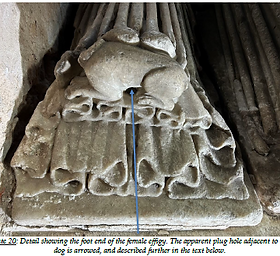
The removal of the bottom half of Mrs Tickhill - her lower part had been fixed in position using a wooden dowel. Probably inserted as a repair when the tomb was moved to its present position during the Victorian era.
Thomas on a trolley in a temporary position in the Nave

The couple re-united in the north aisle (albeit the wrong way round), pending transportation to Skillington's workshop next week.
The Tickhill Tomb Restoration


Local Aston on Trent History of National Importance Awarded Heritage Fund Grant
Aston on Trent residents are celebrating a grant award of £30,000 from The National Lottery Heritage Fund for a major restoration and conservation project. The funding has been made possible thanks to National Lottery players.
Within the Grade 1 listed All Saints’ parish church, lies a rare example of a 15th century alabaster tomb; of cultural significance as a work of art and reference to the social history of England at that period of time.
The Tickhill Tomb is a memorial to Thomas Tickhill an attorney at law to the Duchy of Lancaster, carved from Chellaston alabaster by Master sculptors Prentys and Sutton, noted for their work for royalty and the nobility. Thomas Tickhill and his family were living in Aston on Trent at that time, one of the new emerging middle-classes.
Unusually, the tomb is jointly for Tickhill and his wife depicted holding hands, unique to memorials in the late 14th and 15th centuries with only 38 know examples.
Martin Nicholson, project manager with responsibility for the fabric of the church explains; ‘We have been concerned for some time at the deterioration of the tomb from moisture. A thorough examination by specialists Skillington Workshops recommended repositioning and conserving this remarkable tomb with sympathetic repairs where appropriate to avoid potential loss forever. It also allows us to engage with our local history group, village school and residents as the conservation work is in progress. We could not have conducted this project without a Heritage Fund grant so it’s very exciting to know we are restoring a tomb of such importance’.
Thomas Tickhill
Thomas Tickhill (possibly spelled Tykhull) was Attorney at Law for the Duchy of Lancaster, a large area of lands owned by King Henry IV (The Crown) and held by John of Gaunt
Tickhill was responsible for the legal processes for land & property sales, conveyancing, tenants rents etc
He owned an estate in Aston with links to Shardlow
We think he was first married to Agnes then later Elizabeth with whom he shares his tomb (history is a bit vague on his marriages)
Prentice & Sutton were renowned Chellaston stonemasons to the Crown and were commissioned by Tickhill to make his double tomb which is made from local alabaster. If you look carefully at the tomb you’ll see the trademark angels of the Chellaston masons. Prentice & Sutton being known for their links with the nobility.
The tomb is unusual for being a joint tomb with Tickhill and his wife holding hands and the fact that Tickhill was classed as a ‘commoner’ although influential; one of the rising ‘middle-classes’. At their feet you’ll see their dogs, these carvings were mutilated during the Puritan period.
The tomb has been assessed as being rare and of ‘local & national significance’, hence the funding by The National Lottery Heritage Fund
The tomb is being moved, restored and conserved due to its deterioration and that of the church wall through damp
Tickhill died around 1431 (we think)
Photos of the tomb before the restoration began